
SLATE
Synth Lab for Texture Exploration
making synthetic materials, physical
SLATE is a process that takes the surfaces of a specific place, turns them into synthetic textures, and brings them back as physical objects, engraved or milled into stone.
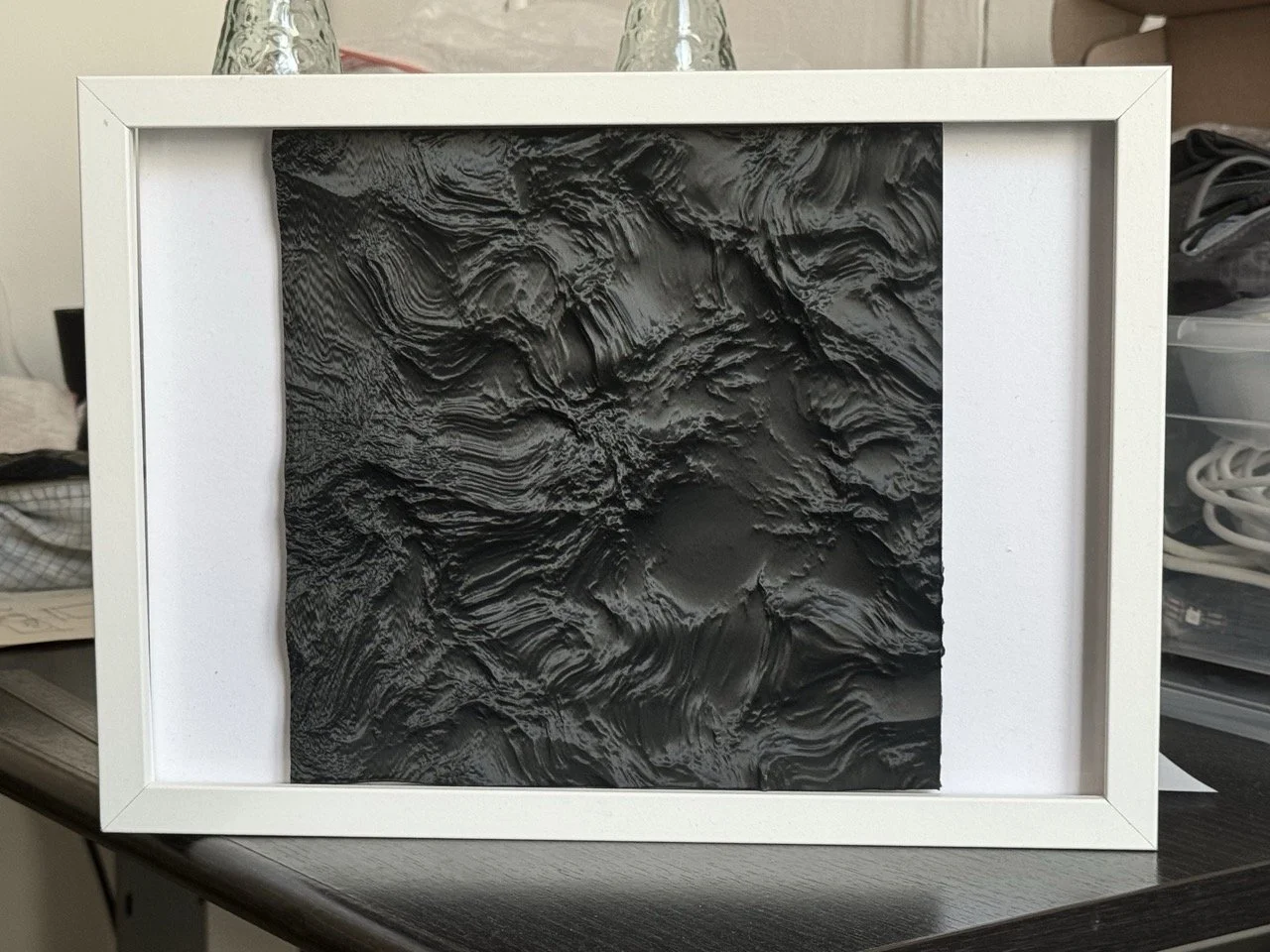
A photo of a wall becomes a height map. The height map becomes a relief. The relief becomes stone again.
Fighting the average
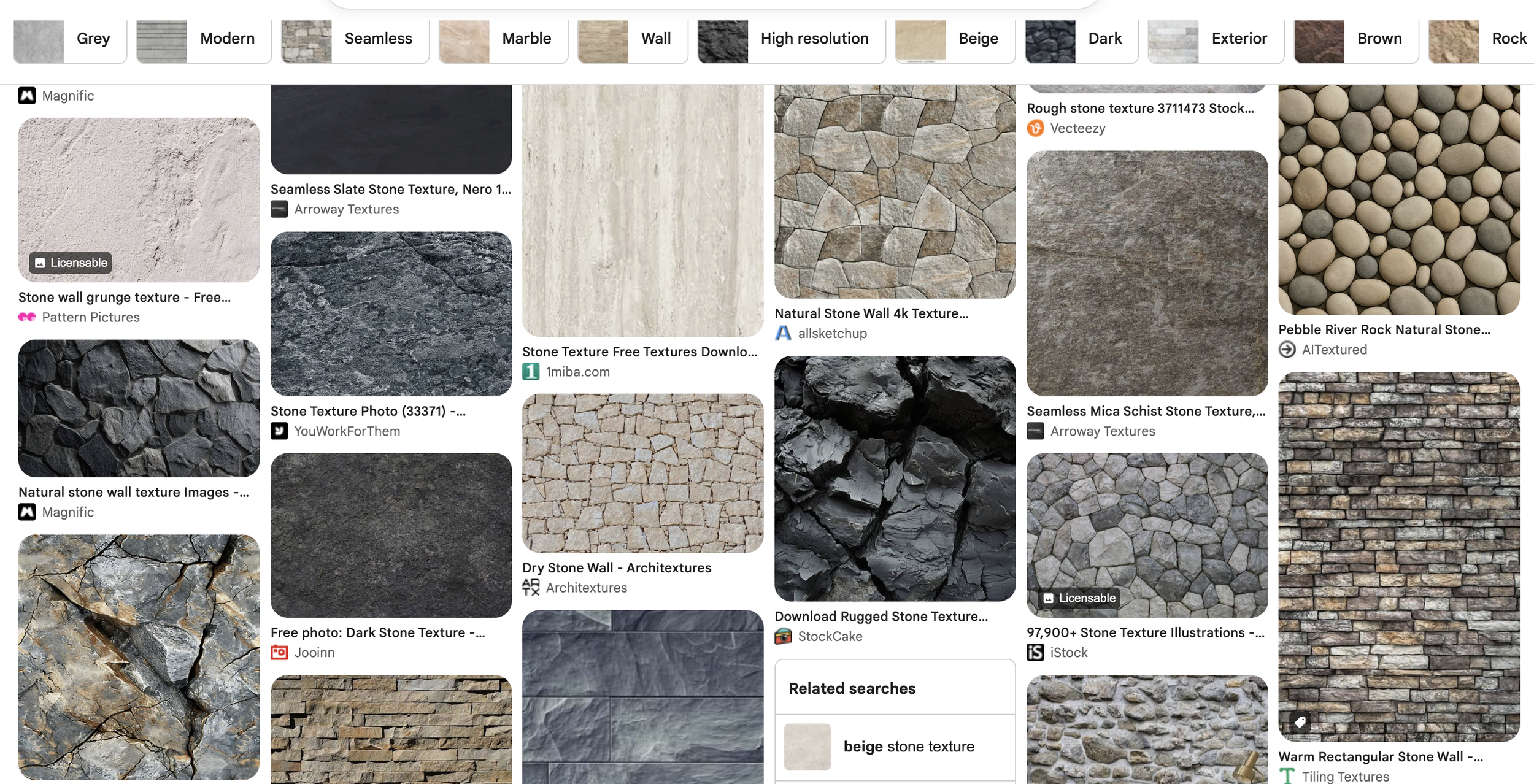
Materials and textures in the real world are rich, local and evolve with time and place. In the digital space, they tend to be bland, generic and static.
Since most of the physical world is informed and built starting from the digital, there's a trend to flatten it, to build things that are boring, average and lacking uniqueness.
This situation has existed in stock materials, textures and samples, but it is exponentially growing with generative models of image and 3D content.
Gen models give back the statistical middle of everything they have seen. And when these textures leave the screen, the average moves into buildings: "stone look" tiles, printed wall panels and interiors that could be anywhere.
The texture looks like material, but it doesn't come from anywhere.
The loss of the local
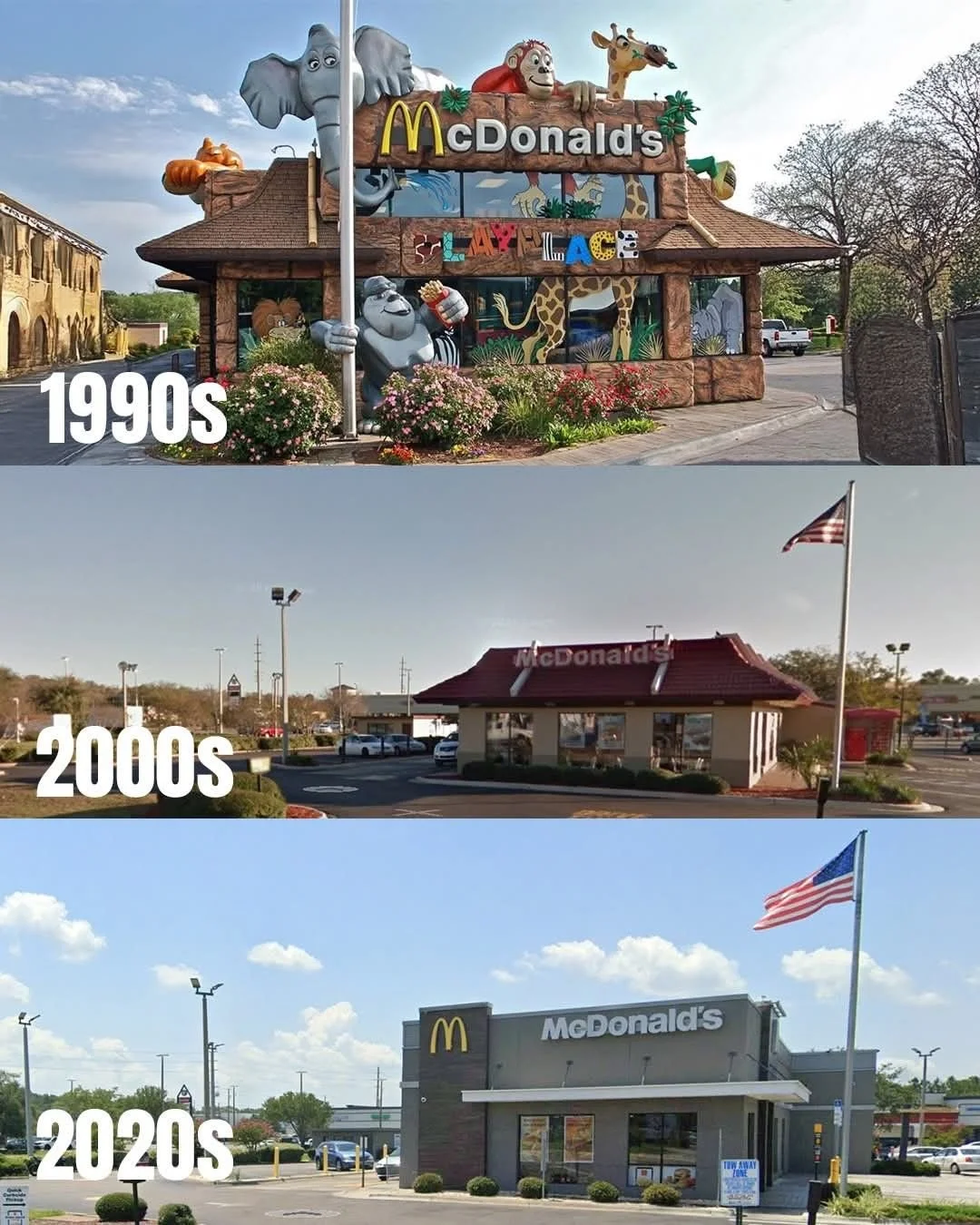
All cities look the same. The same coffee shop with the same reclaimed wood, the same Edison bulbs, the same white tiles, in Barcelona, Berlin or Bangkok. Kyle Chayka called it AirSpace in 2016: a global taste, spread by platforms, that makes places interchangeable. Earlier, Edward Relph described it as placelessness (1976), and Marc Augé as non-places (1992): airports, malls and hotel chains where nothing belongs to anywhere.
Gentrification is also a texture. When a neighbourhood changes, the surfaces change first. The worn shopfront, the hand-painted sign and the patched pavement are replaced with clean, smooth, "neutral" finishes. Often the old material comes back as decoration: a "stone look" panel, an "industrial" print. The look of a place stays; the place goes.
Simplification, at scale. Every step of the digital pipeline loses detail: compression, stock libraries, presets, and now generative models trained to give the most probable answer. The small irregularities (a repair, a stain, the way a local stone breaks) are exactly what averaging smooths out. That's slop: not bad content, but content with the specific removed.
Commercialisation of the average. Generic is easy to sell, easy to scale, and offends no one. A texture that could be anywhere can be sold everywhere. Local materials become a niche, a premium, or a filter.
Terroir. In wine, terroir is everything a place puts into the product: soil, climate, slope, the people who work it. You can taste where it comes from. What would it mean for a digital material to have terroir? To carry the place it was made from, instead of the average of all places?
Going from: stock, averaged, placeless, sold everywhere.
To: local, specific, made from a place and returned to it.
Why physical
Most synthetic textures never leave the screen. They live as image files, as skins on 3D models, as backgrounds. They are seen, but never touched.
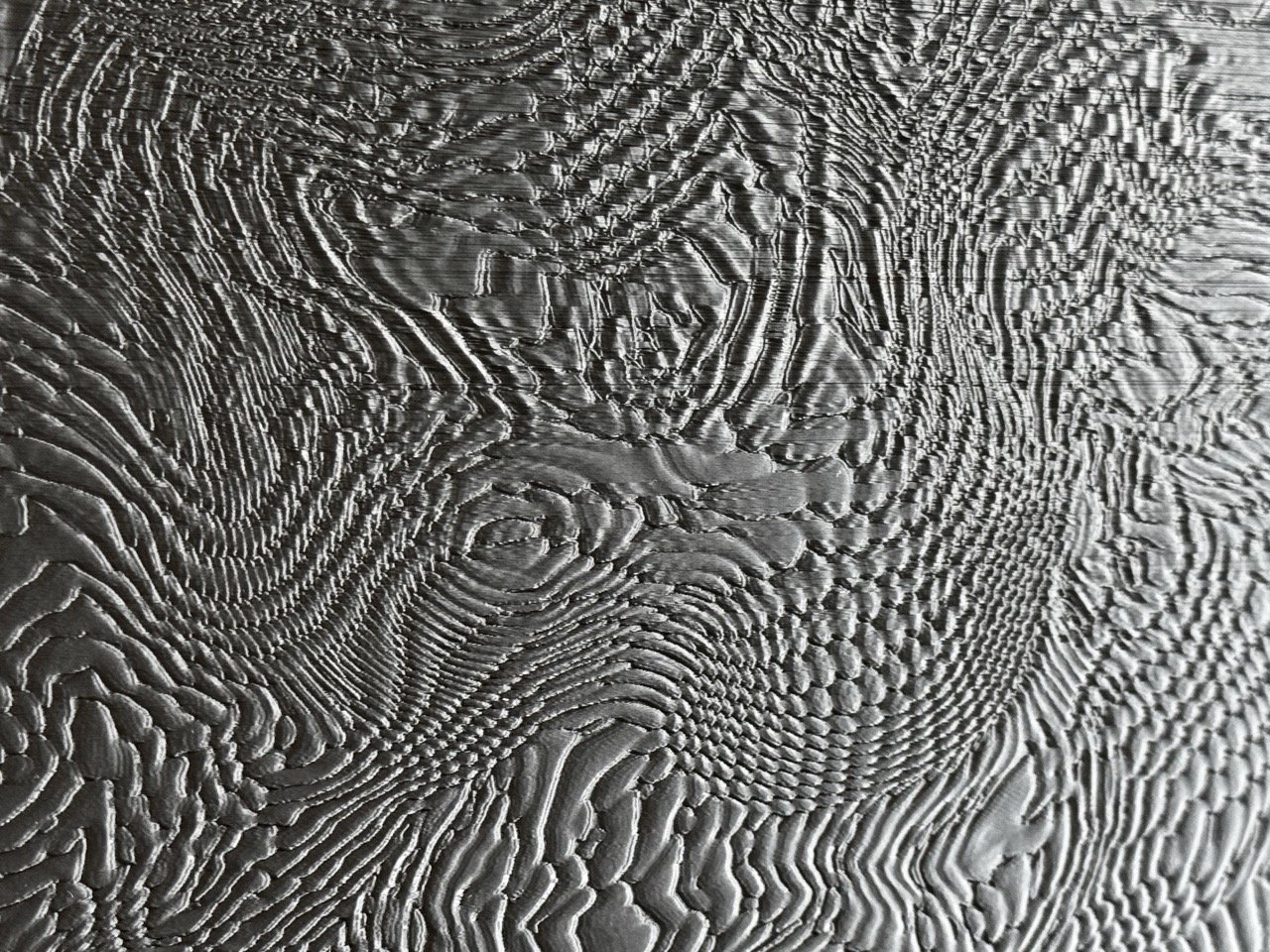
SLATE goes the other way. A synthetic texture becomes something with weight and temperature, that changes with the light of the room, that you can run your fingers over and see under raking light. It can be exhibited, felt, lived.
Once they are physical, they belong to this environment, and are shaped by it, like all of us.
The process
Five stages, from a place to a physical part.
What goes in / comes out photos, media, knowledge depth maps, texture bending, data shifts textures, maps, meshes laser engraving, CNC, etching slate panels, sound panels, decorative pieces My role place-based artistic research custom tool, manual fine-tuning, performance with a production partner as a product or service
1. Place · locale · context
Every piece starts with a place, a theme or a story: a building, a neighbourhood, a landscape, a challenge, a story.
This stage is artistic research. Before and during the photos, I gather media and knowledge: what the place is made of, who made it, what it lives from, what is changing. Photo walks on site, often with people who know the place better than any dataset. Walls, pavements, cobblestones, lichen, worn fabric, carved stone, repairs and stains: whatever carries the place.
Phone or DSLR, nothing special. The photos are the raw material, and each one keeps its provenance: where, when, who.
2. Digital craftsmanship
This is where the photos become workable material, and where the work is done by hand.
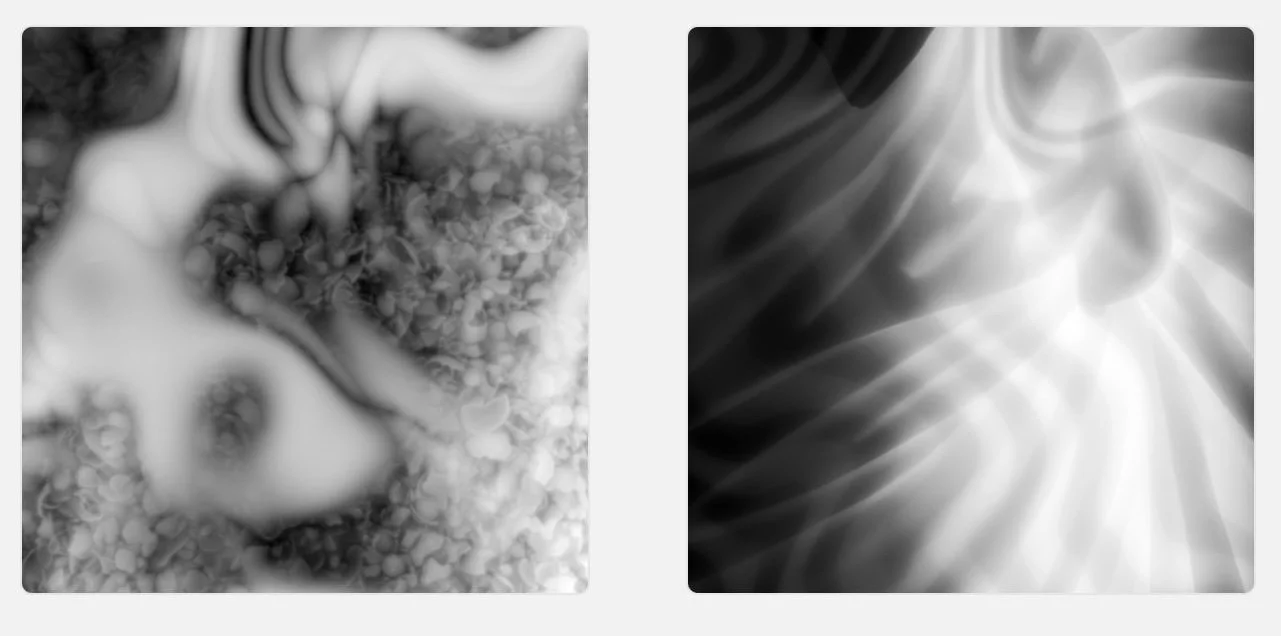
Depth maps. Machine vision reads each photo and estimates how far every point is. That becomes a height map: a grey image where white is high and black is carved. The geometry comes only from depth, never from the colours of the photo. A dark stain doesn't become a hole; a crack does.
Texture bending. Several photos can be layered: one is the base, another lands on it as a crossfade, a mask or a blend. Procedural patterns (cracks, marbling, bark, craters, waves, weaves...) can be bent into the photo relief, or the photo into them. Symmetries fold it: tile, mirror, kaleidoscope, polar, fractal.
Data shifts. Every value can move: contrast, scale, rotation, the way two layers meet. In Drift mode they wander slowly on their own, and I pull them back.
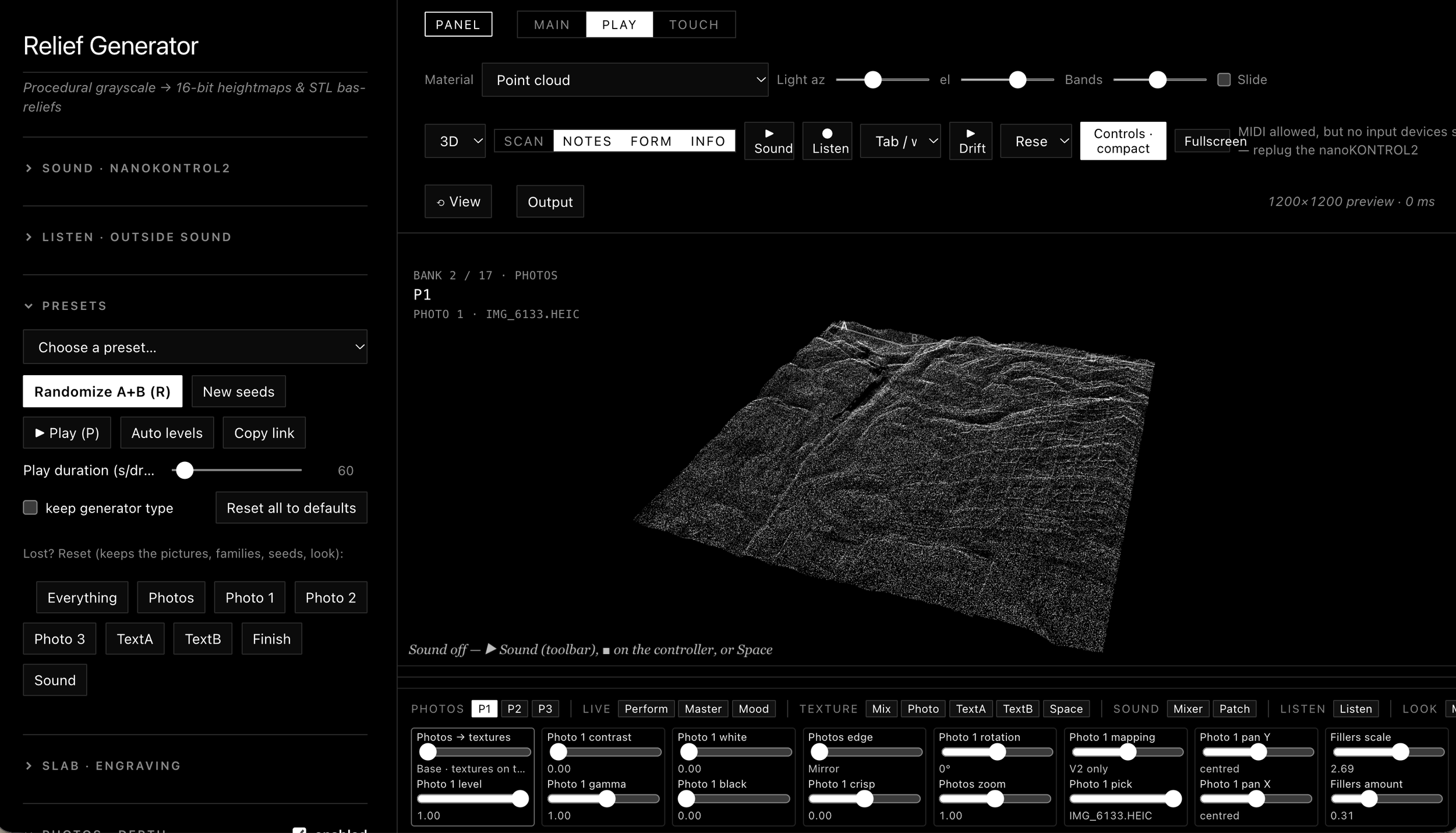
I do all this with a custom tool, played with a MIDI controller: eight faders, eight knobs, and the result changes in real time in 2D and 3D.
Parametric design gives exact values, but only what the formula allows.
Generative design gives surprises, but you can only pick from what comes out.
Manual fine-tuning lets me do both at the same time: the tool proposes, and I keep adjusting while I watch the result change. Ten small moves, not one big decision.
Performative. The texture can also be heard. A scanline sweeps across the relief and plays it as music: kicks on the peaks, snares on the steep edges, hats on the rough parts, drones from the height. Flat is calm, texture is music. It works both ways: moving the sound also reshapes the relief. So shaping a texture can be a live performance, and the slab at the end of the set is the one that gets made.
3. Synthetic materials
The output of the craft stage is a synthetic material: no longer the photographed wall, but a new texture made from it.
Textures: the finished surface, viewed lit, in 3D, or with materials (plaster, porcelain, graphite, jade...).
Maps: 16-bit height maps (65,536 levels instead of 256) and normal maps, usable in 3D software, games or XR as well as for fabrication.
Meshes: watertight 3D files (STL) at real size, ready for a machine.
A depth map isn't a good relief yet, so this stage also translates it. The depth is equalised, the big jumps are compressed, the small ones are kept, and detail is boosted at several scales without blurring the edges.
4. Digital fabrication
The same map can become different objects, depending on depth and scale.
Production runs through partners and distributed digital fabrication services, so the same file can be made wherever there's a machine, close to the place it comes from or goes to.
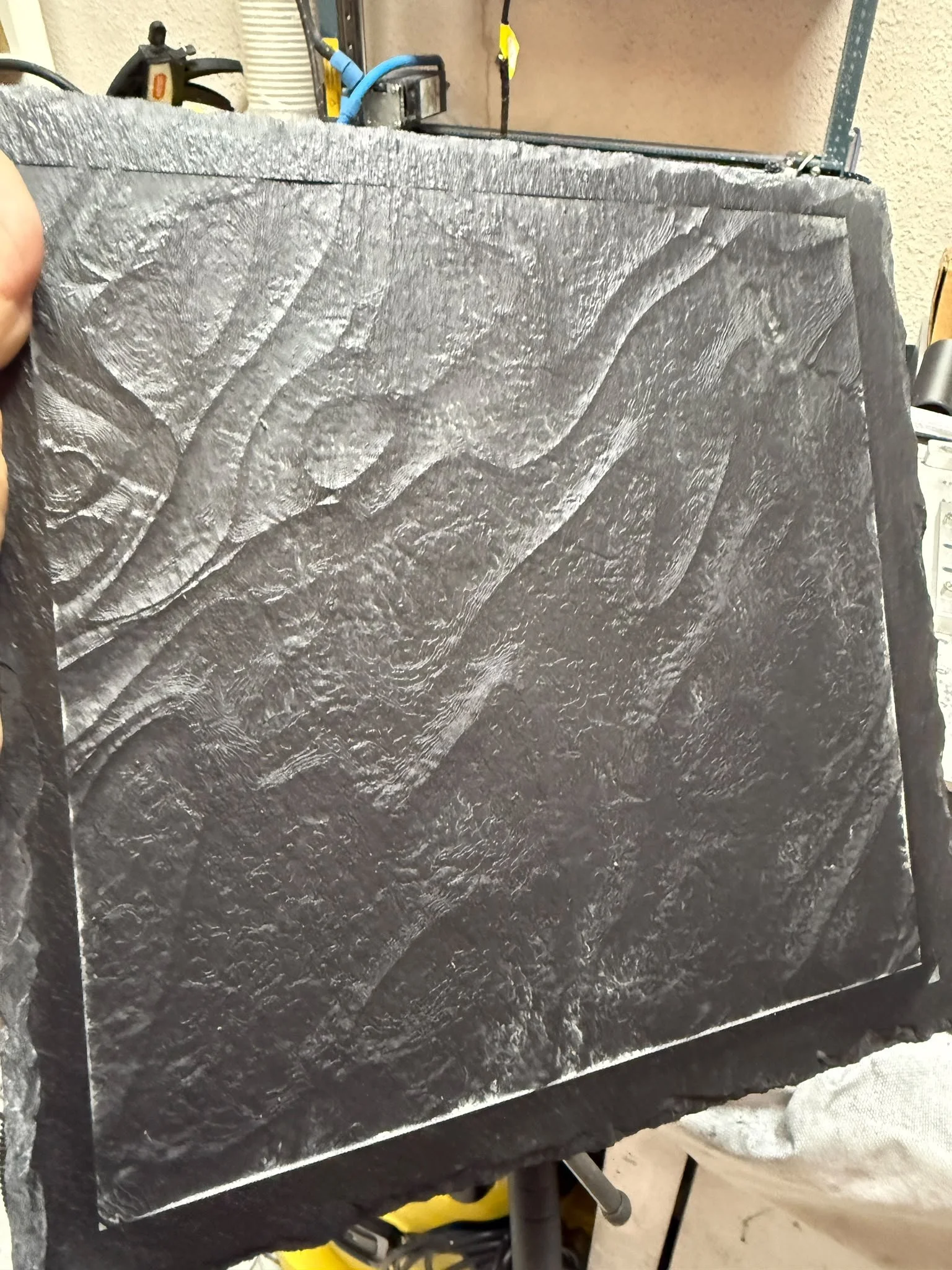
MOPA laser engraving on black slate, for fine detail. The dark stone absorbs the laser's light well, so it engraves cleanly, with high detail and depths of up to 1 mm without issues. The stone stays black: no contrast, no ink. The relief is read only through light and shadow, and by touch. MOPA lasers handle far more depth steps than an 8-bit image can describe, so the full 16 bits of the height map are used.
CNC milling, for deep relief (centimetres instead of a millimetre): wall panels, larger pieces, stone, and acoustic panels (see below).
Etching, for flat surfaces and fine line work.
Backlit films: the relief cut into layers and printed on stacked transparent films, black ink on clear PET, lit from behind. A lighter way to show depth.
3D printing, for quick tests.
5. Physical part
The final object, offered as a product or as a service:
Slate panels: engraved pieces, from a small tile to a wall.
Sound panels: deep reliefs that break sound waves (see below).
Decorative pieces: interiors, objects, art pieces.
Ideally it goes back to the place it came from (the building, the street, the client, the person who owns the wall) with its provenance: which surfaces, where, when, who walked with me.
The output is specific by definition. It can't be reused somewhere else, because it's made from that place.
Directions / MVP
A) Artistic research
My own material exploration. Each piece starts from a place, and the series becomes a map of surfaces: walls, quarries, streets, each one turned synthetic and brought back as stone. Pieces to exhibit beyond a screen, and to touch.
B) Commissions B2B
Custom projects with architects, hotels, companies and institutions. Each commission runs the full process: research the place with the client, collect on site, play the textures together, produce a place-based piece. Engraved panels, a wall, an installation, an acoustic surface. Possible spaces: lobbies, hotel rooms, offices, public buildings.
C) An accessible webapp B2C
A consumer version: a bass-relief web app where anyone can turn their own photos into a depth slate. A piece of your village, the landscape, the bark of a tree in your garden.
Upload, play, order, and receive the engraved stone.
Under the hood
For the process, I built my own workflow: SLATE UI
As a designer, I often build the tools I need instead of adapting my work to existing software.
Runs in the browser (WebGL2), also on phones, with a small depth server on my own machine (an 8 GB Dev GPU).
Depth models: Depth Anything 3 (default, any photo), Depth Anything V2 (finest far terrain) and Apple's Depth Pro (sharpest near detail).
Photos: two photo layers, each with its own level, tone, zoom and mask, meeting through the same blend kinds as the patterns; plus a gallery of already-processed photos to pull from.
Patterns: 22 procedural generators, blended with 12 modes (add, warp, fold, interference, morph...), with symmetry options (tile, mirror, kaleidoscope, polar, fractal).
Control: KORG nanoKONTROL2, with banks for each layer, soft takeover, and a Drift mode where every parameter wanders slowly on its own.
Sound: a small modular synth read from the relief, quantised to a key and a 16-step clock, with scenes and a Mood knob across six genres. Sets can be recorded as WAV.
Exports: 16-bit PNG/TIFF height maps, watertight STL, film PDFs, and a link that reproduces the exact same texture later.
Background
SLATE continues a line of work on synthetic materials:
Deep Textures (RunwayML residency, 2020): my first experiments generating materials, textures and normal maps with machine learning (Pix2Pix, StyleGAN).
VR TERROIR (S+T+ARTS EC[H]O, HLRS Stuttgart): hyperlocal materials and avatars shaped by specific places.
SLOPJECTS: the averageness of AI-generated 3D objects.
SLATE takes the same question (what is the material of a place?) and brings it back to physical matter.
SLATE is an ongoing project. Work in progress.
(next dev) Panels that shape sound
*This is an open direction, to be developed and tested.
Rooms full of flat, hard surfaces (glass, concrete, polished stone) are loud. Sound bounces back in one direction, echoes build up, and lobbies, restaurants and offices become tiring. Acoustic treatment usually means foam, felt or grey fabric panels: functional, and the same everywhere.
A designed relief could do both jobs: carry the texture of a place and change how the room sounds. A flat wall sends a sound wave straight back, whole. A deep, irregular relief breaks the wave: every crack, ridge and hollow sends a small piece of it back at a slightly different time and in a different direction, so the echo falls apart into a soft, spread-out reflection.
Relief depth Starts to scatter from about What it affects up to 1 mm (laser) far above hearing nothing audible 10 mm 8.5 kHz only the brightest highs 30 mm 2.8 kHz sibilance, clatter, harsh highs 50 mm 1.7 kHz speech clarity starts here 100 mm 850 Hz voices, a busy room
CNC milling: Only deep relief (several centimetres) changes how a room sounds. The same height map can be engraved finely for a small piece and milled deep for a wall.
Scattering, not absorbing. Slate is dense and hard, so a deep slate relief would mainly break the waves (diffusion): scatter the echoes instead of soaking them up. To also absorb, the panel needs a porous or open material, or holes and a cavity behind it. So the acoustic version may not be slate at all: CNC-milled wood, cork or wood-wool boards with the same local texture, or slate tiles with slots and an absorber behind.
From texture to diffuser. Acoustic diffusers are already designed reliefs: Manfred Schroeder's quadratic residue diffusers (1970s) are wells whose depths follow a number sequence, tuned to a frequency range. A next step could be to mix this kind of calculated depth sequence with the photo relief, so the surface is tuned for sound and still looks like the place it comes from.
< article written with the help of [claude] from a project notes document drafted by Bernat >